


Lowfree Flow84 is the latest episode in my passion for mechanical keyboards. I described this as a mechanical keyboard that Apple would make, for reasons that are both good and bad, but more on that later. Update: There is a new version with touch sliders for volume and brightness. Price and conclusion Last section.
This is one of a relatively new breed of thin mechanical keyboards, something that seemed like an oxymoron just a few years ago.
What exactly is a mechanical keyboard?
Given that Apple-style chiclet keyboards currently dominate the market, and many Mac users aren’t old enough to remember anything that came before, it’s probably worth starting at the beginning.
The MacBook keyboard and various Apple Magic Keyboards are constructed with ultra-slim keys sitting atop a two-part scissor mechanism. This provides elasticity and pushes each key up after use.
The mechanism is quiet in use and, most importantly for Apple’s purposes, requires very little height. This means it can be used with ultra-thin MacBooks. (I’ll gloss over here about when the company went too far on this…)
However, scissor keyboards also have major drawbacks, the biggest of which is the lack of feel. From a tactile or auditory point of view, it is simply not satisfying to use. That’s where mechanical keyboards come in.
These use more robust switches under each key and have much longer travel distance. Depending on the type of switch you use, you may hear a clicking, rattling, or rattling sound. These three terms are most commonly used to describe changes in hearing.
Fans of mechanical keyboards prefer greater physical movement as well as absolute tactile and auditory feedback when pressing a key. Combining the two not only improves accuracy, but counterintuitively, it also tends to increase typing speed.
Finally, most mechanical keyboards offer nearly endless customization options. You can purchase a variety of switches, each with a unique sound and feel, and a wide range of keycaps in shapes, colors, finishes, typefaces, and more.
Introducing the thin mechanical keyboard
For a very long time, you’ve been paying to make your own choices.
- Thin and compact layout, but the scissor keyboard feels uncomfortable
- While offering a great feel, mechanical keyboards are physically large and tall.
The width and depth of a mechanical keyboard can be reduced using various shrink key options. The full-size keyboard has all the keys working, including the function keys, numeric keypad, and navigation keys like PgUp and PgDn. It has over 100 keys and is known as a 100% keyboard.
Over time, various other options have emerged, such as removing the number pad and function keys (accessed using key combos). This makes the mechanical keyboard as much as 40% smaller than a full-sized keyboard while maintaining standard-sized keycaps.
However, a problem that has only been solved in the last few years has been lowering the height of mechanical keyboards without compromising range of motion or feel. Many companies have figured out how to do this, and the thin keyboard was born.
low free flow 84
The Lowfree I’m reviewing is the Flow84, which takes its name from the key of 84. Size-wise, it takes up 75% of the keyboard and has function and navigation keys, but no number pad. (There is also a Flow100 version with keypad.)
look
This is the first reason I say this is the mechanical keyboard Apple would make today. It has a very beautiful and minimal design. It comes in black and white, and if you put the white version side-by-side with Apple’s Magic Keyboard, the similarities are obvious.
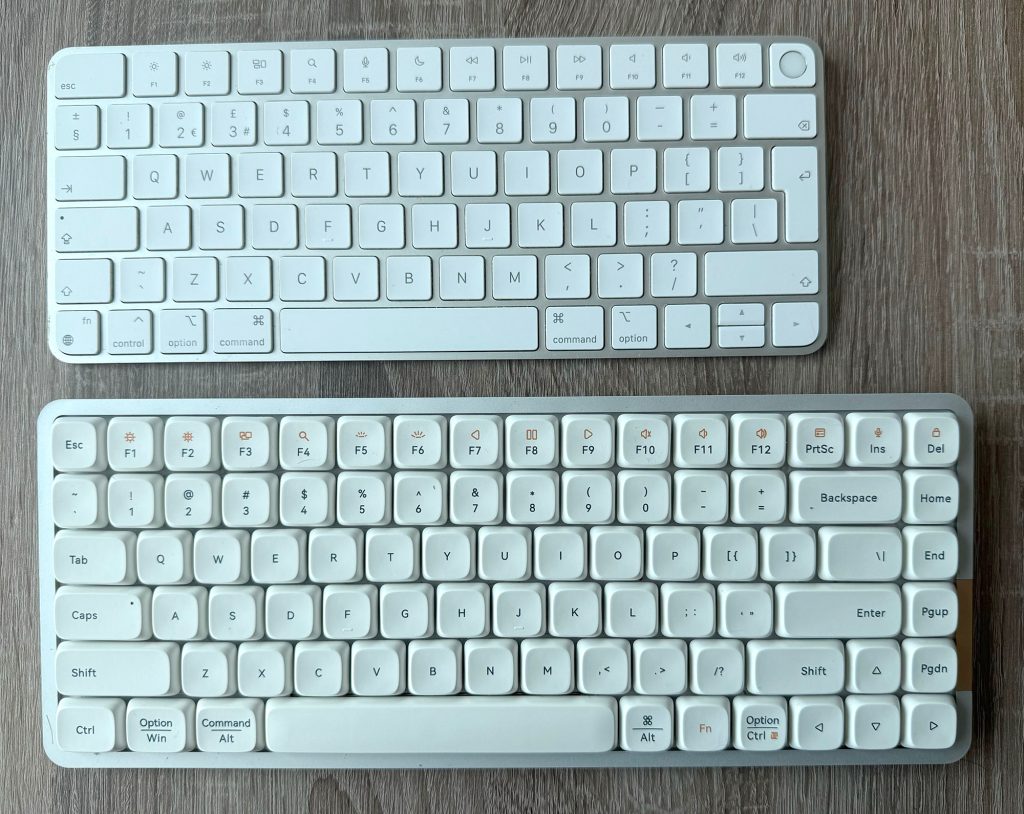
It’s slightly off-white, but not as creamy as it appears in this light.
The thin design is obvious when viewed from the side. You may either like or dislike the copper-colored brand plate. Personally, I think it’s better not to use it, but it’s not that unpleasant. The matching legs are similar and even shorter.
The keys are backlit, but I personally have never used backlighting on my desktop keyboard. Switching between the three supported Bluetooth connections and backlight intensity are controlled by key combinations.
This low-profile design is made possible in part by the extremely shallow keycaps.
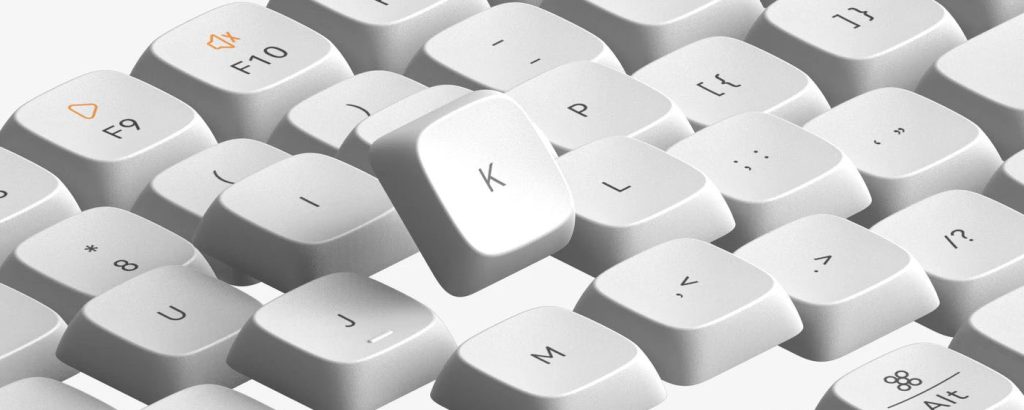
This means you don’t have the flexibility to buy a set of keycaps if you want a different look, but Lofree many There are a variety of options and prices start at $50 per set. This is a little more expensive than the standard set, but not by much.
customization
Normally I would go from look to feel, but there are some issues here.
One of the main advantages of mechanical keyboards is that they can be used in combination. Want a different look? Remove the keycaps. Want a different feel? Please choose another switch.
To be clear, Lofree offers a lot of keycap options, so that’s okay. However, there are additional limitations when it comes to switches. The keyboard uses Kailh switches. I personally think these are better, but some may prefer Cherry. That’s not an option.
I’m generally a clicky switch type of person, so I usually end up choosing the Kailh Wizard set. But I can’t. For reasons I can’t explain, the white keyboard just has ghost switches and the black keyboard has phantom switches. You can’t specify the keyboard you want like other mechanical keyboard companies. You can order addition You can purchase a set of switches of your choice, but it will cost you an additional $59.
This is the second reason why I say this is an Apple-made keyboard. It’s a true “you can use whatever specs you want, as long as Apple chooses” attitude.
The exact same thing applies to firmware. Most mechanical keyboards support software remapping. Need page up and down keys above Home and End? No problem. Replace the keymap and remap its functionality in software. But that’s not the case with this keyboard. There is no remapping feature. Again, this reminds me of the “Apple knows best” approach.
So I received a white keyboard with ghost switches.
Oh, and there’s one final piece of customization missing. It’s the legs. Most mechanical keyboards have three positions: feet down, low position, and high position. The legs of the Flow84 are fixed in a so-called low position. This angle works well, but again you don’t have a choice.
feel
The keyboard feels like it offers excellent build quality. The all-aluminum casing gives it a solid and heavy feel. Fit and finish standards are well within Apple’s standards.
When it comes to typing, the Ghost switch is a linear switch with no clicky feel. I wanted to exchange it. But…not yet.
Lofree says these switches give the smoothest typing experience, and I have to say I totally get that. The feel is really beautiful.
I might still replace it, but I can’t deny that it’s low noise and feels very smooth, yet still has enough positive feel and auditory feedback to make for reliable typing. Two weeks later, I’m still using it and I feel like I need to replace it less and less.
Half of my on-off relationships have been resolved.
I talked about my intermittent obsession with mechanical keyboards. On the plus side, I in large quantities I prefer the feel of typing, and I find that both my typing speed and accuracy improve when using this. The downside is that they are traditionally large beasts, making them difficult to transport when traveling.
However, the Flow84 measures 12.5 inches x 5 inches x 1 inch and weighs 1.3 pounds, so it’s not a far-fetched proposition if you’re considering adding it to your travel kit or stashing it in your backpack. It also takes up almost no extra space on your desk than the Magic Keyboard, as you can see from the comparison above.
Battery life is on the short side at 40 hours, but I’m in the habit of charging it weekly and it works fine.
But another reason I keep going back and forth between mechanical and chiclet keyboards is because it’s hard to switch between the two. I use the mechanical one on my desk, and the chiclet one for traveling and leisure use in the living room. It may be tiring to constantly adjust, but I think this may be here to stay. it’s just So It’s nice to use
Price and conclusion
The Lofree Flow84 costs $159, but the company is currently offering it for $139. As always, it’s worth comparing prices on Amazon. However, there is a flow, so be careful when doing so. light Half aluminum, half plastic version.
There are also cheaper options like the NePhy Air75, ranging from $120 to $135 depending on original and V2. But the most Apple-like thin mechanical keyboard is the Lofree Flow84.
Yes, I would like to check the switch options when ordering. Yes, I would like to remap and layer my software. But if you want a mechanical keyboard that fits snugly into your Apple-only setup and provides a beautiful typing experience, you might think the modest additional investment and Apple-like limitations are worth it.
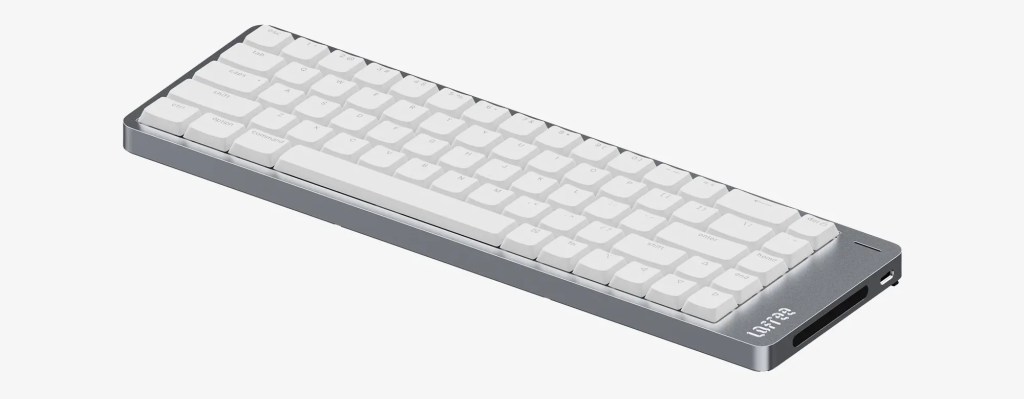
What’s new: The Lofree Flow 2 model is also available, available in a 68-key version (no function keys) for $139. The USP of this model is the touch-sensitive slider on the right edge of the keyboard. By default, this controls the volume and, if you hold down the function key, controls the screen brightness. These are the two most common uses for function keys, so it may be practical to eliminate them to achieve the slimmer profile of the 68-key version. I also use media keys, so this isn’t the ideal option for me, but it might work for some people. This can be seen here:
Featured accessories
Main photo: 9to5Mac collage of images on Unsplash by Lowfree and Codioful





