


ASUS has been releasing a number of new display products over the past few years, and there are no signs that the progress will stop. One of the latest and truly most exciting new releases is the $1300 Asus ProArt 6K display. This provides excellent value for Mac users looking for more than 4K or 5K.
The $1300 Asus ProArt Display 6K PA32QCV features a native resolution of 6016 x 3384 within its 32-inch panel. For those keeping score at home, that’s the same 218 pixel density as Apple’s Pro Display XDR. Admittedly, the Pro Display XDR is on a whole other level when it comes to display quality thanks to its 1600 nits of brightness and 576 local dimming zones, but its base price of $4999 (without stand and matte texture) reflects this most clearly.
ASUS takes a decidedly more economical approach with its 6K display, offering the same amount of screen real estate as Apple’s monitors at less than a quarter of the cost. But that doesn’t mean it sacrifices the ability to provide users with a display that performs admirably considering the price. Watch our hands-on video review to learn more. For more news, be sure to subscribe to 9to5Mac on YouTube.
Transparency: ASUS provided this display for review. Asus has no say in the thoughts or opinions expressed and was unable to view this review prior to publication.
Required specifications
- 31.5-inch 6K (6016 x 3384) IPS display
- 218PPI
- 178° wide viewing angle
- 60Hz refresh rate
- Dual Thunderbolt 4 connectivity
- HDR10 and VESA DisplayHDR™ 600
- 98% DCI-P3 and 100% sRGB wide color gamut
- Ergonomic design with tilt, swivel, pivot and height adjustment features
- Price: $1,300
video review
Subscribe to cyberstorehut on YouTube for more videos
Quality of design and construction
Few display manufacturers seem willing to compete with Apple’s Material Design team, which uses aluminum and glass for both the 6K Pro Display XDR and 5K Studio Display. And Asus is no exception. The ProArt Display 6K is constructed almost entirely of plastic, with the exception of a few parts such as the stand, and is reinforced with metal.
One of the biggest drawbacks of such a design decision is that it makes the desktop slightly less stable. Plastic displays tend to wobble when you type compared to displays made from higher quality materials. This isn’t a big deal, but you might notice it if you’re using an Apple-designed display.
Like other monitors in the ProArt lineup, the Asus Display 6K features slim 3cm bezels. The bezels are slimmer than those seen on Apple’s first-party displays, but the effect is interrupted by a large chin that shows off the ASUS logo and physical controls at the bottom.
Of course, an ergonomic stand is included in the box, which gives this display great flexibility. The monitor can tilt +23° to -5°, swivel +30° to -30°, pivot +90° to -90°, and rise 0 to 130mm. Say what you want about the copious amounts of plastic, but it’s pretty nice to have a stand this high-performance included (for free).
connectivity
One of the biggest benefits of using a third-party display is the additional I/O when compared to a first-party Apple display. One upstream USB-C port is available on the Pro Display XDR or Studio Display, along with three downstream USB-C ports. While the Apple Studio Display has three downstream USB3 10Gb/s ports, the Pro Display XDR still has an impressive USB2 480Mbps speed limit for the three downstream ports. The Pro Display XDR has been out for almost 6 years and I can’t believe this is still an issue.
In comparison, the ASUS ProArt Display 6K has a truly embarrassing amount of I/O.
- 1 x Thunderbolt 4 upstream (up to 96W)
- 1 x Thunderbolt 4 port (15W)
- 1 x USB-C USB 3.2 Upstream Port USB Hub
- 2 x USB-A ports USB 3.2 Gen 1 (5Gb/s and 4.5W)
- 1 x USB-C port USB 3.2 Gen 1 (5Gb/s and 15W)
- 1 x HDMI 2.1
- 1 x DisplayPort 1.4 DSC
- 1 x 3.5mm headphone jack
- 1 x Kensington lock slot
- automatic KVM
- Control your MacBook via ASUS DisplayWidget Center
The best part about I/O is the inclusion of dual Thunderbolt 4 ports that support daisy chaining. This means you can easily connect a second monitor to your Mac through the display, reducing the amount of cables you need to connect to your Mac. Alternatively, you can use the second Thunderbolt port to daisy-chain another Thunderbolt cable device, such as a high-speed SSD. Apple’s first-party monitors act as termination points for upstream connections, so it’s nice to have a monitor like this to help simplify cabling.
One caveat when using a daisy-chained setup is that it doesn’t seem to support high refresh rates. I daisy-chained Asus’ 27-inch PA27UCGE HDR monitors. Supports up to 144Hz when connected directly to your Mac with a USB-C cable. However, when connected to the second Thunderbolt 4 port on the ProArt Display 6K, the refresh rate is limited to a maximum of 60Hz. Luckily, you can connect your second display directly to your Mac, so this doesn’t have to be an issue, but there are some things to keep in mind.
Of course, Asus also includes both HDMI 2.1 and DisplayPort 1.4 with DSC support. Both of these are great options if you want to connect other devices to your display, such as a game console or PC. However, note that even though these interfaces can handle higher refresh rates, the ProArt Display 6K only maxes out at 60Hz.
The display’s rich I/O includes an upstream USB 3.2 port, which allows your Mac to access peripherals connected to any of the three USB 3.2 Gen 1 ports on the display. This display also features automatic KVM support for seamlessly sharing the keyboard and mouse between multiple computers.
MacBook users in particular may want to download Asus’ DisplayWidget Center, which allows you to control many settings within the OSD menu directly from your Mac. You’ll also be able to control the screen brightness of your external display using keyboard shortcuts in your MacBook’s feature row.
display quality
Let’s be honest, the reason most people consider the Asus ProArt Display 6K is because it has more pixels per dollar than anything else on the market. Asus offers users an impressive pixel count of 20,358,144 pixels across a 31.5-inch diagonal area. This is almost a 40% increase over the 27-inch Asus ProArt Display 5K’s 14,745,600 pixels. 9to5 mac Reviewed earlier this year.
Let me tell you, having extra screen real estate is a nice luxury. The image below will help you visualize how much additional screen real estate is provided by the 6K panel.
In the real world, consider video editing in Final Cut Pro. While it is possible to view 4K video at 100% while editing on a 5K display, it will be very cramped and leave little room for things like the Inspector, Project Timeline, and Project Library. Comparing the differences between 5K and 6K displays in these scenarios can help you be more productive when working with a single monitor.
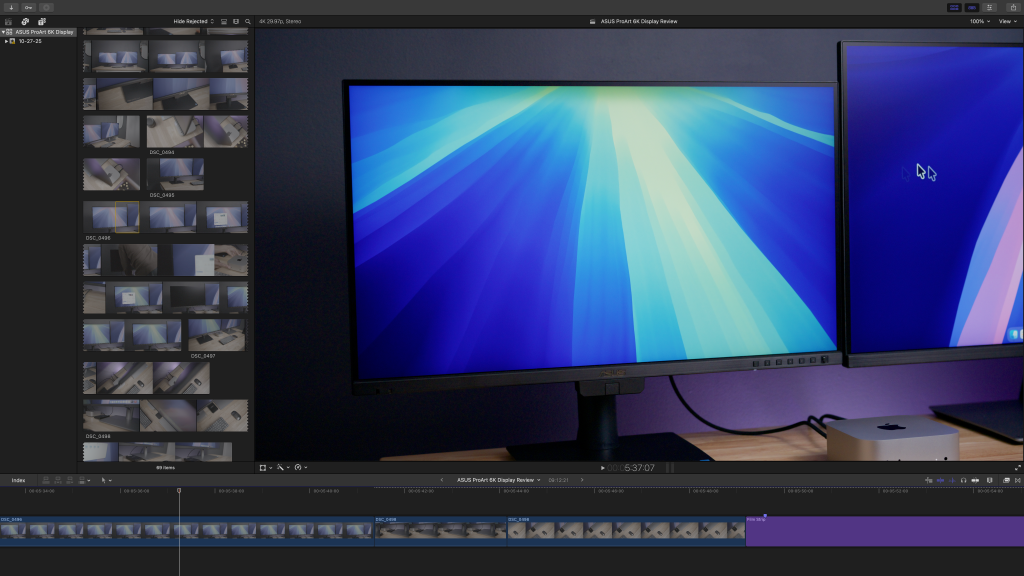
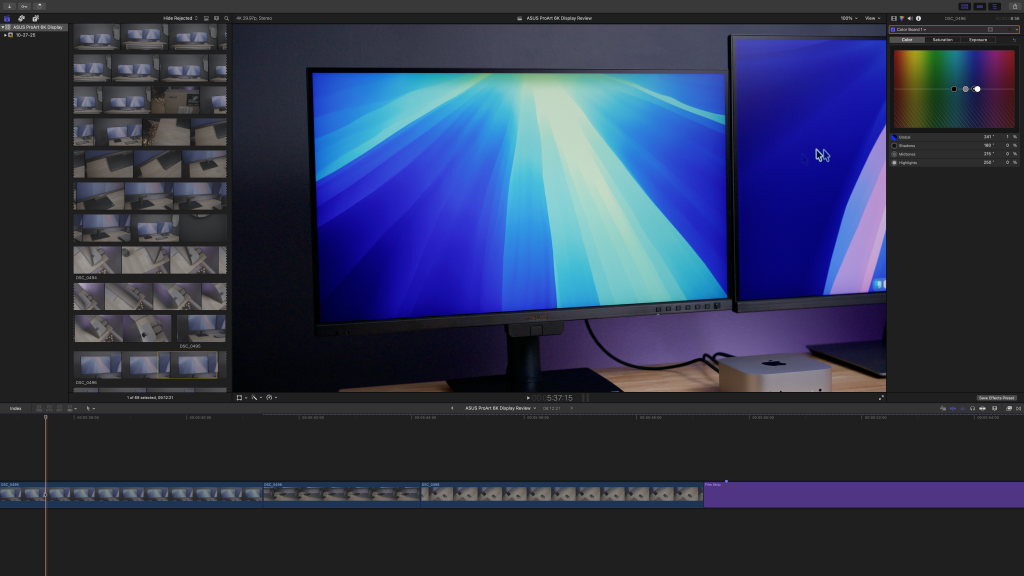
How does the Asus ProArt Display 6K perform in other important areas such as color accuracy, brightness capabilities, and uniformity? Asus proudly states that the ProArt Display 6K’s color accuracy is Delta E < 2. This evaluation measures the difference between the original input colors. Content and actual colors displayed on screen. The smaller the delta between these values, the more accurate the color.
A Delta E < 2 rating is at the higher end of the spectrum, but there are displays with even better color accuracy, such as the aforementioned PA27UCGE. This display boasts a Delta E <1 rating and is positioned for creative professionals.
To test Asus’ claims, I used the Calibrite Display Pro HL colorimeter with Calibrite Profiler and Portrait Display’s Calman to measure color accuracy, brightness, uniformity, and more.
The company’s claims were proven valid when it came to measuring Delta E. Asus claims 98% DCI-P3 coverage, and that’s exactly what I measured in my testing. It claims 100% sRGB coverage and measured 99.8% in my testing. Obviously, these tests have a margin of error and each panel is slightly different, but the overall gist is that the accuracy lives up to the claims.
MacBook users will appreciate the M Model-P3 color presets that Asus includes in the OSD. Switching to this preset matches the color performance of your MacBook display, so colors look the same when the two machines are placed side by side.
One final thing to note is that, like most third-party display products, the ProArt Display 6K features a matte coating. I’ve never been a fan of matte coatings, so I usually go for glossy screens or 10s when I have the option.
The marketing terms Asus uses regarding coatings are: lux pixelwhich basically means it has an anti-glare, low-reflection coating that performs better than typical matte coatings. All matte screens have some loss of clarity and clouding due to the diffuser layer, but I found text to be reasonably sharp and quickly got used to it.
9to5Mac’s opinion
The Asus ProArt Display 6K is a great value with all the features it offers. You get significantly higher resolution, better color accuracy, and more I/O for less than Apple’s Studio Display. If you want to upgrade your monitor, ASUS makes a strong impression.
That said, I’m also looking forward to taking LG’s UltraFine 6K display for a test drive in the coming days. Find out how this display compares to the Asus 6K in a future review.
Please share your thoughts in the comments section below.


(Tag translation)Display



