


Wi-Fi 7 Triple Threats from Amazon’s Charming Business
Estimated Reading Time: 10 Min
At the end of 2023, Amazon still ruled out the cover of its latest and largest Eero system. Eero Max 7 with Wi-Fi 7.
The heel-hot Netgear Orbi 970 series, which was announced the same week, added the Wi-Fi 7 and some heel-filled upgrades, making the Max 7 the fastest Eero Mesh system ever.
And while still in place after 18 months or so, there are other – more affordable options when it comes to increasing the Eero Wi-Fi mesh system to Wi-Fi 7 via two new entries that arrived in February 2025: the Eero 7 and the Eero Pro 7.
Sitting under the Max 7 of Eero Hierarchy, the new Wi-Fi 7 Duo makes multi-gigabit speeds more accessible and rounds out future home networks for years to come.
All three Eero Wi-Fi 7 systems use the latest wireless standards, but vary considerably when it comes to speed, band support, and price tags.
So whether you’re looking for a budget-friendly upgrade or a non-competitive power, this comparison between the Eero 7 range will help you decide which one is right for you.
(Ah, there’s also an outdoor Eero 7 option, but I’ll ignore that for now.)
Eero Pro 7 vs Eero Max 7 vs Eero 7: Price
The Eero 7 is the most affordable way to get Wi-Fi 7 from Amazon’s Meshy business, but it doesn’t have 6GHz and is slower.
The Eero Pro 7 offers a powerful mid-ground with tri-band support and fast speed, while the Eero Max 7 has a rather eye-opening price tag, but it’s the ultimate choice for anyone looking for the fastest and most future prevention system.
The Eero 7 costs $169.99 for one unit, $279.99 for two packs, or $349.99 for three access points.
For the Pro 7 range, it’s $299.99, $549.99, or $699.99, depending on your choice of 1,2 or 3 packs. With the MAX 7, the same configuration will go up to $599.99, $1,149.99 and $1,699.99.
For UK shoppers, if you trade that dollar sign for 1 pound, there’s the answer.
As always, with Amazon Branded Tech, it’s wise to wait for various sales events like Prime Days and Black Friday, where prices are always discounted.
For example, in Black Friday 2024, Amazon is 25% off the price of the Eero Max 7, so we were hoping for the same for the newer models this year as well.
Eero Pro 7 vs Eero Max 7 vs Eero 7: Design and Connection
Physically, the three models are quite different. Notably, the standard Eero 7 takes on a set-top box-like look in the 130 x 64.1mm Pro 6e and 6+ range.
The Eero Pro 7 is large at 180.4 x 146.4mm and has a stand-up form factor like the Eero Max 7.
Reference: Eero 7 vs Eero Pro 6e
In terms of ports, both the Eero 7 and the Eero Pro 7 feature two Ethernet ports, but the Pro 7 will be phased out with the base model’s 2.5 Gigabit port and five Gigabit support.
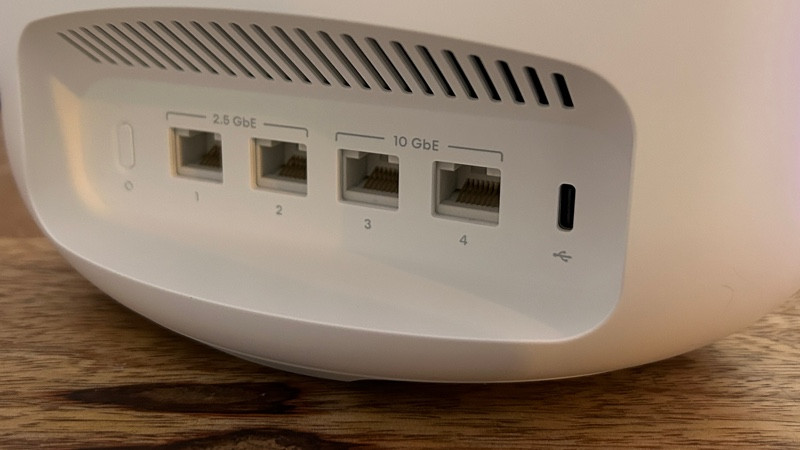
The Eero Max 7 is all out with two 10 Gigabit and two 2.5 Gigabit Ethernet ports, making it ideal for wired connections.
All three models include a USB-C port, which is simply used for power.
Eero Pro 7 vs Eero Max 7 vs Eero 7: Performance and Speed

One of the biggest differentiators is speed and band support. The Eero 7 is a dual-band system (2.4GHz and 5GHz), which limits overall capacity compared to its expensive siblings.
Both the Eero Pro 7 and Eero Max 7 support Tri-Band Wi-Fi (2.4GHz, 5GHz, and 6GHz), providing significant speed improvements and reduced crowding.
The Eero 7 has dual-band radio (2.4GHz and 5GHz) and is rated at the BE5000 and offers wireless speeds of up to 1.8Gbps and wired speeds of 2.3Gbps. The Eero Pro 7 introduces a Tri-Band setup (additional 6 GHz) and is much higher rated for the BE10800, supporting wireless speeds up to 3.9Gbps and wired speeds up to 4.7Gbps.
The Eero Max 7 is taking its way further than what features a triband configuration with 4×4 MIMO in both 5GHz and 6GHz bands. The BE20800 rating offers wireless speeds of up to 4.3Gbps and impressive 9.4Gbps over wired connections.
The Eero Max 7 boasts the most wireless link thanks to its 4×4 wireless configuration at 5GHz and 6GHz, while the Eero Pro 7 has a 2×2 setup for every band. The dual-band Eero 7 also has a limited 2×2 configuration.
The Max 7’s 10 Gigabit Ethernet port means, at least in theory (as a lucky enough to find an ISP that rivals the pace), you can download 4K movies in 10 seconds, or download a hefty 50GB game to your PS5 in under a minute.
However, even 2.5 Gigabits are fast and lightning bolts, and wired speeds are not an issue for years, regardless of the Eero you buy from three. These are very future proof systems.
Thanks to multi-link operation (MLO), Wi-Fi 7 devices can connect at multiple frequencies simultaneously to increase speed. That’s the real key to speed improvements that Wi-Fi 7 promises.
All three Eero systems support Eero’s Truemesh, Trueroam and TrueChannel technologies. This means seamless connectivity and reduced interference.
Eero Pro 7 vs Eero Max 7 vs Eero 7: Coverage
Both the Eero 7 and Eero Pro 7 offer up to 2,000 square feet of coverage per unit, making them suitable for small to medium sized homes.
Meanwhile, the Eero Max 7 extends coverage to 2,500 square feet per unit, making it a better option for larger homes or homes that need more robust coverage.
With the 3-pack system, the Eero 7 and Eero Pro 7 can extend to up to 6,000 square feet, while the Eero Max 7 reaches 7,500 square feet, ensuring reliable connectivity in larger spaces.
Obviously, if you want to expand these coverage ranges further, you can add as many Eero nodes to your mix as you want. You can also extend the Eero Range using the Echo Smart Speaker.
Eero Pro 7 vs Eero Max 7 vs Eero 7: Features and Apps

All three of these Eero systems are full-fledged smart home hubs, act as material controllers and thread border routers, and also have Zigbee connections, making it easier to sync directly with things like Philips Hue through Alexa.
They are all backward compatible, as always in the Eero way. Get new Eeros songs and dances with your existing Eero kit.
Whatever your Eero Wi-Fi 7 system is your choice, you’ll set up and control things through an Eero app that works perfectly in the cloud.
This means there are no advanced settings, such as manually adjusting the network channel. Everything is handled automatically based on what the system deems best.
I also can’t find an option to separate the network into individual bands, but with Wi-Fi 7’s MLO (Multilink Operation) technology, there’s little reason to do so.
The Eero app offers a clean, user-friendly experience. Free to set up user profiles, assign devices to individuals, and schedule internet access times. However, more advanced controls require an Eero Plus subscription ($99.99/£99.99 per year) that unlocks features like ad blocking, web and app filtering, malware bytes, one password, and bundled subscription to a VPN with Guardians.
Eero Pro 7 vs Eero Max 7 vs Eero 7: Which is better for you?
If you’re looking for an affordable way to keep your home out of the future with Wi-Fi 7, the Eero 7 is a great entry point. We offer reasonable speed and coverage at reasonable prices.
The Eero Pro 7 is the perfect mid-ground option, offering a tri-band setup and faster speed without breaking the bank.
However, if you want the best and best with ultra-fast wired and wireless performance, the Eero Max 7 is your ultimate pick.
For most people, the Eero Max 7 is going to be overkill, so the new duo is welcomed by Eero’s Wi-Fi 7 Arsenal.
Ultimately, your choice will come down to your specific needs, home size and budget.
Whether you’re casual internet users or hardcore gamers with multi-gigabit internet, there’s an Eero Wi-Fi 7 system that fits the bill.
FAQ
Yes, but in a different range. The Eero 7 supports up to 2.3Gbps wired and 1.8Gbps wireless, while the Eero Pro 7 increases it to 4.7Gbps wired and 3.9Gbps wireless. The Eero Max 7 is the fastest and handles up to 9.4Gbps of wired and 4.3Gbps of wireless, making it ideal for users using a multi-gig internet plan.
The Eero Max 7 offers maximum coverage and supports up to 2,500 square feet per unit. Both the Eero 7 and Eero Pro 7 cover up to 2,000 square feet, so if you want coverage, you need multiple units, or you need the Max 7.
Yes, all three models offer high-speed low-latency connections, but the Eero Max 7 is the perfect option for serious gamers and 4K/8K streamers. A 4×4 radio configuration in 5GHz and 6GHz bands improves bandwidth distribution and reduces congestion. The Pro 7 is also a solid choice, but the standard Eero 7 is more suitable for medium gaming and streaming needs.
Yes, all Eero 7 Series models are backwards compatible with previous Eero models. This means that they can be mixed and matched with older Eero devices in the same mesh network. However, to get the most out of Wi-Fi 7 speed and features, we recommend using only Wi-Fi 7 compatible Eero devices in your setup.
Eero Pro 7 vs Eero Max 7 vs Eero 7: Compared specifications
| device | Eero 7 | Eero Pro 7 | Eero Max 7 |
| Wi-Fi Standard | Wi-Fi 7 (IEEE802.11a/b/g/n/ac/ax/be) | Wi-Fi 7 (IEEE802.11a/b/g/n/ac/ax/be) | Wi-Fi 7 (IEEE802.11a/b/g/n/ac/ax/be) |
| Number of radios | 2;Dual Band | 3; Triband | 3; Triband |
| Speed rating | BE5000 | BE10800 | BE20800 |
| Wi-Fi coverage | Up to 2,000 square feet. | Up to 2,000 square feet. | Up to 2,500 square feet. |
| Support speed | Wired up to 2.3 Gbps Up to 1.8 GBPS wireless |
Up to 4.7 Gbps wired Up to 3.9 Gbps wireless |
Up to 9.4 Gbps wiring Up to 4.3 Gbps wireless |
| Radio Frequency | 2.4GHz: 2×2 5GHz: 2×2 |
2.4GHz: 2×2 5GHz: 2×2 6GHz: 2×2 |
2.4GHz: 2×2 5GHz: 4×4 6GHz: 4×4 |
| Ethernet | Two Auto-Sensing 2.5 Gigabit Ethernet Ports, 1 USB-C Port | Two Auto-Sensing 5 Gigabit Ethernet Ports, 1 USB-C Port | Two Auto-Sensing 10 Gigabit Ethernet Ports, Two Auto-Sensing 2.5 Gigabit Ethernet Ports |
| size | 130 x 64.1mm | 180.4mm x 146.4mm | 221.9mm x 183.9mm |



